

Reviewed by Souad Charifi Hadj, registered pharmacist nº 2676.
Dark circles can be significantly reduced —and sometimes almost eliminated— but the key is knowing their type. Not all dark circles respond to the same treatment: some are due to pigmentation, others to blood vessels showing through very thin skin, and others to volume loss that creates a shadow. In this guide, we'll explain why dark circles appear, how to identify your type in 10 seconds in front of a mirror, and which natural cosmetic active ingredients have real evidence to improve them. No miracles, but with what truly works.
What exactly are dark circles?
Dark circles (dermatologists call them periorbital hyperpigmentation or periocular darkening) are that darker, bluish, purplish, or brownish tone that appears on the skin of the lower eyelid. It is one of the most frequent aesthetic concerns of the face, and it's no wonder: the skin around the eyes is the thinnest on the entire body (barely 0.5 mm in some areas, compared to almost 2 mm on the cheek), has very few sebaceous glands, and is subject to constant movement —we blink between 15,000 and 20,000 times a day—. All of this makes it especially vulnerable to dehydration, fatigue, and the passage of time.
The thinness of the skin also explains why dark circles are so visible: anything happening underneath —blood vessels, pigment, or lack of volume— shows through easily.
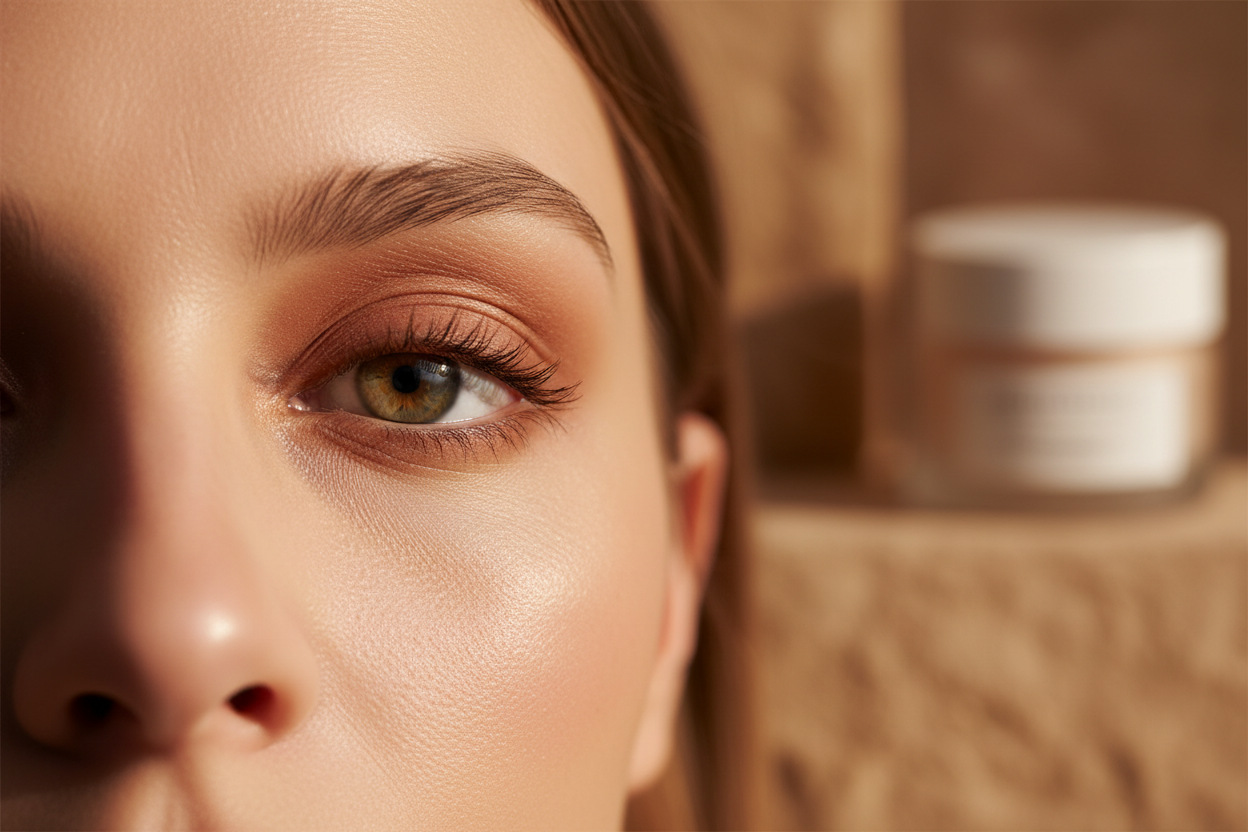
The 3 types of dark circles (and why you need to know yours)
Here's the point almost no one explains, and it makes all the difference between spending money in vain or getting it right. According to dermatological literature, dark circles are classified into three main types, and it's most common to have a combination of several. In fact, in prevalence studies, the mixed type (pigmented + vascular) is the most frequent, followed by the purely vascular.
1. Pigmented dark circles (brown)
These are due to an excess of melanin in the skin around the eyes. They usually have a brown tone, appear more frequently in medium and dark phototypes, and have a strong genetic component. They are also worsened by sun exposure and continuous rubbing (rubbing eyes due to allergies or tiredness). How to recognize them: if you gently stretch the skin of the eyelid outwards, the brown color remains.
2. Vascular dark circles (bluish or purplish)
These are the most common. They appear because blood vessels show through the very thin skin, or because blood stagnates and is poorly oxygenated (which is why the blue-violet tone worsens with tiredness, lack of sleep, or dehydration). How to recognize them: if you press the area or stretch the skin, the bluish tone tends to lighten or disappear momentarily.
3. Structural dark circles (shadow)
Here there is neither excess pigment nor blood vessels: it's pure shadow. With age, we lose collagen, fat, and volume in the tear trough, and a small valley forms that casts a shadow under the eye. How to recognize them: they change a lot depending on the lighting (they worsen with overhead light) and practically disappear if you lie down or if you illuminate the area from below.
Knowing your type allows you to choose well: pigmented dark circles improve with active ingredients that regulate melanin; vascular dark circles, with ingredients that activate microcirculation and strengthen the vascular wall; and structural dark circles, with active ingredients that stimulate collagen and fill (although the most pronounced ones are the domain of aesthetic medicine, not a cream).
Why do dark circles appear? The most common causes
There is rarely only one cause. These are the most significant ones:
- Genetics. Skin thickness, vessel position, and tendency to pigment are inherited. If your mother or father has prominent dark circles, you likely will too.
- Lack of sleep and fatigue. They don't "create" dark circles out of nowhere, but they dilate blood vessels, worsen circulation, and make the skin look paler, which highlights the bluish tone.
- Dehydration. Dehydrated skin looks dull and sunken, and accentuates both shadows and color. In summer, with heat and sun, this factor spikes.
- Sun exposure. UV radiation stimulates melanin (worsens pigmented dark circles) and degrades collagen (worsens structural dark circles). It is the great accelerator of dark circles.
- Age. The progressive loss of collagen and fat thins the skin and accentuates the tear trough.
- Allergies and rubbing. Rhinitis and rubbing the eyes cause inflammation and darken the area.
- Fluid retention and salt. More related to undereye bags and morning puffiness than to color, but it often goes hand in hand.
Can dark circles be eliminated naturally?
Let's be honest, because that's what any of our pharmacists at the counter would ask us: completely eliminating them with cosmetics is rarely possible, especially if they are genetic or structural. What is perfectly realistic is to visibly reduce them: unify the tone, brighten the area, strengthen the skin so it is less translucent, and decongest bags. With consistency, improvement is real; what doesn't exist is a cream that erases dark circles overnight.
The good news is that nature offers scientifically backed active ingredients for almost all types of dark circles. Let's look at them.
Natural ingredients that actually work against dark circles
Caffeine: the ally for vascular dark circles and undereye bags
It is probably the star active ingredient for the eye contour. Caffeine is a vasoconstrictor and stimulates microcirculation, which helps to decongest the area and reduce puffiness and bluish tone. A review of eye contour ingredients published in the International Journal of Women's Dermatology (2024) concludes that creams with caffeine can reduce periorbital hyperpigmentation and also have an anti-wrinkle effect by improving elasticity. Another clinical trial tested a cream with 3% caffeine against periorbital hyperpigmentation, with promising results. Ideal for morning use.
Niacinamide: evens out skin tone
Niacinamide (vitamin B3) regulates melanin transfer, making it very useful for pigmented dark circles. In studies, a cream with 5% niacinamide applied for four weeks significantly reduced pigmentation spots. As a bonus, it strengthens the skin barrier and soothes.
Vitamin K and antioxidants: for vascular congestion
Vitamin K has been studied for its role in vascular pigmentation. In an 8-week trial, a gel combining vitamin K with retinol and vitamins C and E reduced dark circles in almost half of the participants, with the greatest benefit in the vascular type (due to blood stagnation). Antioxidants like vitamin C and E protect from sun damage and provide luminosity.
Vitamin C: light for pigmented dark circles
It deserves special mention. Vitamin C brightens and helps unify the tone of the lower eyelid: in studies on periorbital hyperpigmentation, applied topically, it significantly improved the appearance of the area. It combines especially well with caffeine, which decongests, and with vitamin K.
Bakuchiol and peptides: for structural dark circles
For the shadow caused by loss of firmness, active ingredients that stimulate collagen are of interest. Bakuchiol —"natural retinol"— improves firmness and fine lines without the irritation of retinol, which is key in such a delicate area. Peptides (like palmitoyl tripeptide) help redensify the skin around the eyes.
Hyaluronic acid and vegetable oils: hydration and plumping
Hyaluronic acid plumps and smooths by retaining water, and oils like jojoba or those rich in squalane nourish this thin skin, making it less translucent. Well-hydrated skin disguises both color and shadows.
An important point confirmed by science: formulas that combine several active ingredients usually work better than a single isolated ingredient, precisely because dark circles are almost always mixed.
Step-by-step eye contour routine
You don't need to overcomplicate it. A simple and consistent routine always wins:
- Cleanse gently. Remove makeup without rubbing; aggressive rubbing darkens the area.
- Apply the eye contour with your ring finger. It exerts the least pressure. Apply 2-3 dots and gently pat from the inner corner outwards, without dragging. The amount of a grain of rice for both eyes is enough.
- Morning: formula with caffeine/antioxidants to decongest and protect. Always finish with sunscreen: it's the most cost-effective anti-dark circles gesture there is.
- Night: repairing active ingredients (bakuchiol, peptides, hyaluronic acid) to regenerate while you sleep.
- Consistency. Results around the eyes are seen after 4-8 weeks. Patience.
Habits that make a difference (especially in summer)
The best cream falters if your lifestyle works against it. Four basics:
- Get enough sleep and, if possible, with your head slightly elevated to promote drainage and prevent morning bags.
- Hydrate inside and out. In summer, heat dehydrates the skin and accentuates dark circles and shadows; drink water and don't skip facial hydration.
- Moderate salt intake at night to reduce fluid retention.
- Protect yourself from the sun with sunglasses and SPF. UV radiation is the main accelerator of pigmented and structural dark circles.
Two more gestures that add up: don't rub your eyes —continuous rubbing darkens pigmented dark circles— and take breaks for your eyes if you spend many hours in front of screens, because eye strain congests the area.
A quick trick for puffy mornings: apply cold (a cold spoon or eye contour kept in the fridge). Cold constricts blood vessels and reduces inflammation instantly.
Our pharmacists' recommendation
At Biovardi, our team of pharmacists chooses eye contours with proven effective and natural active ingredients. For dark circles and bags, these two are among our favorites depending on your needs:

Antioxidant Eye Contour with Hibiscus 15 ml — Umoa Cosmetic
Why we recommend it: ideal if your priority is undereye bags, puffiness, and dullness. Its antioxidant and decongestant action helps reduce inflammation and brighten the area. Our choice for the morning routine.

Eye and Lip Contour Cream 15 ml — Esse Skincare
Why we recommend it: perfect for structural and age-related dark circles. Certified organic cosmetics that nourish, redensify, and smooth fine lines around the eyes while caring for the delicate lip area. Our choice for nighttime.
👉 You can see all our natural eye contours for dark circles and bags here.
Not sure where to start?
Each type of dark circle needs different active ingredients, and choosing blindly is throwing money away. Take our free AI skin analysis in 30 seconds and discover what your eye contour —and the rest of your skin— truly needs.
Frequently asked questions about dark circles
How do I know what type of dark circles I have?
Do the mirror test in natural light: gently stretch the skin of the lower eyelid outwards. If the brown color persists, they are pigmented; if the bluish tone lightens, they are vascular; if what you see is a shadow that changes with lighting, they are structural. It is most common to have a mix.
Does caffeine in eye contour really work?
Yes, especially for undereye bags and vascular dark circles. It is a vasoconstrictor and improves microcirculation, which decongests the area. Studies also attribute some effect on hyperpigmentation and wrinkles. It works best applied in the morning.
Can dark circles be removed forever?
With cosmetics, they are visibly reduced, but completely eliminating them is difficult if they are genetic or structural. Consistency with good active ingredients, sun protection, and healthy habits achieve real and lasting improvement.
Is regular moisturizer good for the eye contour?
It can hydrate, but the skin around the eyes is different and benefits from specific textures and active ingredients (gentler, ophthalmologically tested). A good eye contour provides what facial moisturizer doesn't cover.
At what age should I start using eye contour cream?
There's no fixed age. If you have dark circles or want to prevent them, you can start in your twenties with light, hydrating formulas; from 30-35 onwards, adding anti-aging active ingredients like bakuchiol or peptides makes perfect sense.
How long does it take to see the effect of an eye contour cream?
The decongestant effect of caffeine can be noticed in minutes or hours. For real changes in tone and firmness (niacinamide, vitamin C, peptides), you need to be consistent for 8 to 12 weeks, which is the skin's renewal time.
Does lack of sleep cause dark circles?
It aggravates them, especially vascular ones: lack of sleep worsens microcirculation and causes blood to accumulate under that thin skin, darkening the area. It is not the only cause —genetics plays a big role— but getting enough rest makes a big difference.
Do natural eye contours work the same as conventional ones?
Active ingredients with evidence —caffeine, vitamin C, niacinamide, peptides— exist in both conventional and natural formulas. At Biovardi, we opt for versions of natural and certified origin, without unnecessary ingredients, ensuring efficacy and tolerance for such a delicate area.
Conclusion
Dark circles are not a flaw to be "erased" at all costs, but rather a sign of thin skin that requires tailored care. Identify your type, choose supported active ingredients —caffeine and antioxidants for vascular and bags, niacinamide for pigmented, bakuchiol and peptides for structural— and be consistent. Improvement will come, though not overnight.
And if you're overwhelmed by all this information, let us guide you: take our free AI skin analysis in 30 seconds or discover our entire selection of natural eye contours and anti-aging treatments. Your gaze will thank you.
References
- A review of the efficacy of popular eye cream ingredients. International Journal of Women's Dermatology (2024).
- Classification by causes of dark circles and appropriate evaluation method. PubMed.
- Clinical Efficacy of a Novel Topical Formulation on Periorbital Dark Circles. Journal of Cosmetic Dermatology (2025).
- Review of the efficacy of popular eye cream ingredients. PMC.
- The Efficacy and Safety of 3% Caffeine Cream on Reduction of Periorbital Hyperpigmentation (2024).
- Tranexamic Acid Plus Vitamin C Mesotherapy in Periorbital Hyperpigmentation: Randomized Clinical Trial. PMC.
This article is for informational purposes only and does not substitute for the advice of a healthcare professional. If you have very pronounced or suddenly appearing dark circles, consult a dermatologist.
Free Skin Analysis
See what your eyes are asking for
With one photo, we detect dark circles, fatigue, and the area where they are most noticeable. You receive three routines at three price levels, with the key product highlighted in case you only want to start with one.
Less than a minute. No registration and no commitment.